
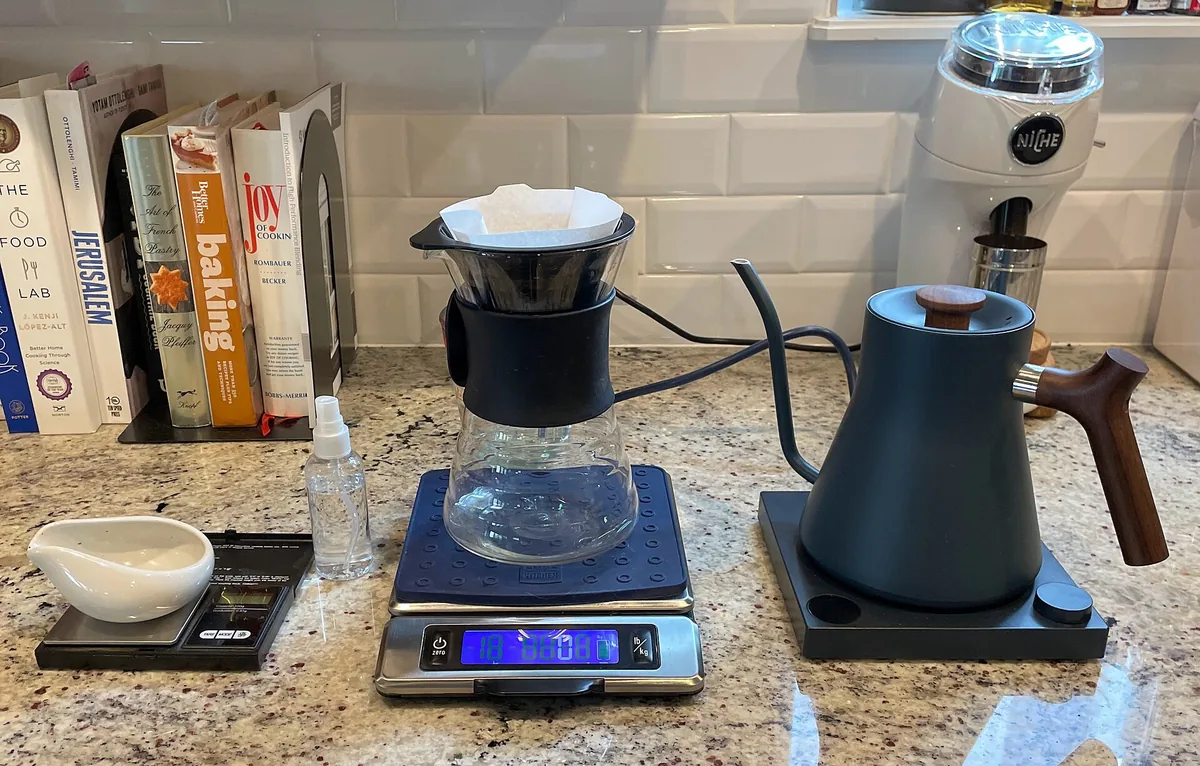
A gooseneck kettle is the one upgrade that changes your pour-over more than any brewer, and the reason is simple: the spout. A normal kettle pours a thick, fast stream that floods the coffee bed and churns the grounds. A gooseneck’s long, thin spout pours a slow, narrow stream that you can aim precisely, so you can pour in the slow spirals that even extraction depends on. If you own a V60 and a regular kettle, the kettle — not the brewer — is the bottleneck in your setup.
Fellow Stagg EKG Pro: the best gooseneck kettle, full stop
The Fellow Stagg EKG Pro is the best pour-over kettle you can buy, and it is the one most serious home brewers end up with. It is a 0.9-litre electric gooseneck with a temperature display, a hold function, and a counterbalanced handle that makes a slow pour feel effortless. Fellow lists it at $179.95 in the US. The Pro adds a full-colour screen, a scheduling function, a 15 to 60-minute hold, and a 2-year warranty over the original Stagg EKG — and the original is now sold refurbished only, so the Pro is the one to buy new.
What makes the Stagg pour well is the spout geometry. The gooseneck is long and narrow, and the flow rate responds precisely to how far you tilt the kettle, so you can pour a thin stream for a bloom and a slightly faster stream for the main pours without the flow surging. The temperature control is the other half of the value: set it to 94°C and it holds there, so you stop guessing whether the water is hot enough. The 0.9-litre capacity is enough for two mugs, and the kettle heats from room temperature to 94°C in about three minutes.
The Stagg EKG Pro’s weakness is its price. At $179.95 it costs more than a V60, a grinder, and a scale combined. It is worth it if you brew pour-over every day, because temperature and pour control are the two variables you touch on every single brew. It is not worth it if you brew pour-over twice a week — buy a cheaper kettle and spend the difference on beans.
Hario Buono: the best stovetop gooseneck, and the cheapest way in
The Hario Buono is the best stovetop gooseneck kettle and the cheapest way into controlled pouring. It is a 1.2-litre stainless steel kettle with a gooseneck spout, made by the same company that makes the V60, and it costs around $40 to $50. It has no temperature control and no display — you heat it on the stove, take it off the heat, and pour. The spout is narrower than the Stagg’s and the flow is slightly faster, but it is still far more controllable than any regular kettle.
The Buono’s weakness is temperature. Without a display, you are guessing the water temperature, and the usual method — boil, then wait 30 to 45 seconds off the boil — lands you roughly at 93 to 96°C but not precisely. If you pair the Buono with a cheap clip-on thermometer, or with a temperature-controlled kettle later, it works well. Buy the Buono if your budget is tight, if you like the ritual of a stovetop kettle, or if you want to find out whether pour control matters to you before spending $180 on a Stagg. Do not buy it if you already know you want temperature control — you will end up buying the Stagg anyway.
Budget electric goosenecks: good enough, with one compromise
If you want electric temperature control without the Stagg’s price, the budget electric goosenecks are good enough. The Cosori and Chefman electric goosenecks, both around $60 to $70, offer a temperature display and a hold function in a 0.8 to 1.0-litre body. Their spouts are wider than the Stagg’s and the pour is slightly less precise, but they are a large step up from a regular kettle and they hold temperature well enough for pour-over.
The compromise is build quality and longevity. The budget kettles use thinner steel, cheaper electronics, and shorter warranties — typically one year against the Stagg Pro’s two — and the temperature display is less accurate, sometimes reading a few degrees off the real temperature. If your budget caps at $70, a budget electric gooseneck is the right buy and it will make noticeably better coffee than a stovetop kettle. If you can stretch to the Stagg Pro, the pour control and the build quality are worth the difference over years of daily use.
Do you actually need a gooseneck?
Yes, if you brew pour-over more than a couple of times a week. The pour is one of the four variables that decides the cup, and a regular kettle makes a controlled pour physically impossible — the stream is too thick and too fast, and it floods the bed. You can make decent pour-over with a regular kettle and a careful hand, but you cannot make repeatable pour-over, because you cannot reproduce the same pour twice.
No, if you brew with an immersion method — a French press, an AeroPress, or a Clever Dripper — because the water is added all at once and the pour does not matter. A gooseneck is a pour-over tool, and buying one for a French press is wasted money.
What to buy
Buy the Fellow Stagg EKG Pro at $179.95 if you brew pour-over daily and want the best pour control and temperature control available — check Fellow’s official site for the current price before you buy, since it changes. Buy the Hario Buono at around $40 to $50 if you want the cheapest way into a controlled pour, or if you prefer a stovetop kettle. Buy a budget electric gooseneck at around $60 to $70 if you want temperature control without the Stagg’s price. Whichever you choose, the rule is the same: pour slowly, pour in spirals, and keep the stream thin enough that the coffee bed never floods.