
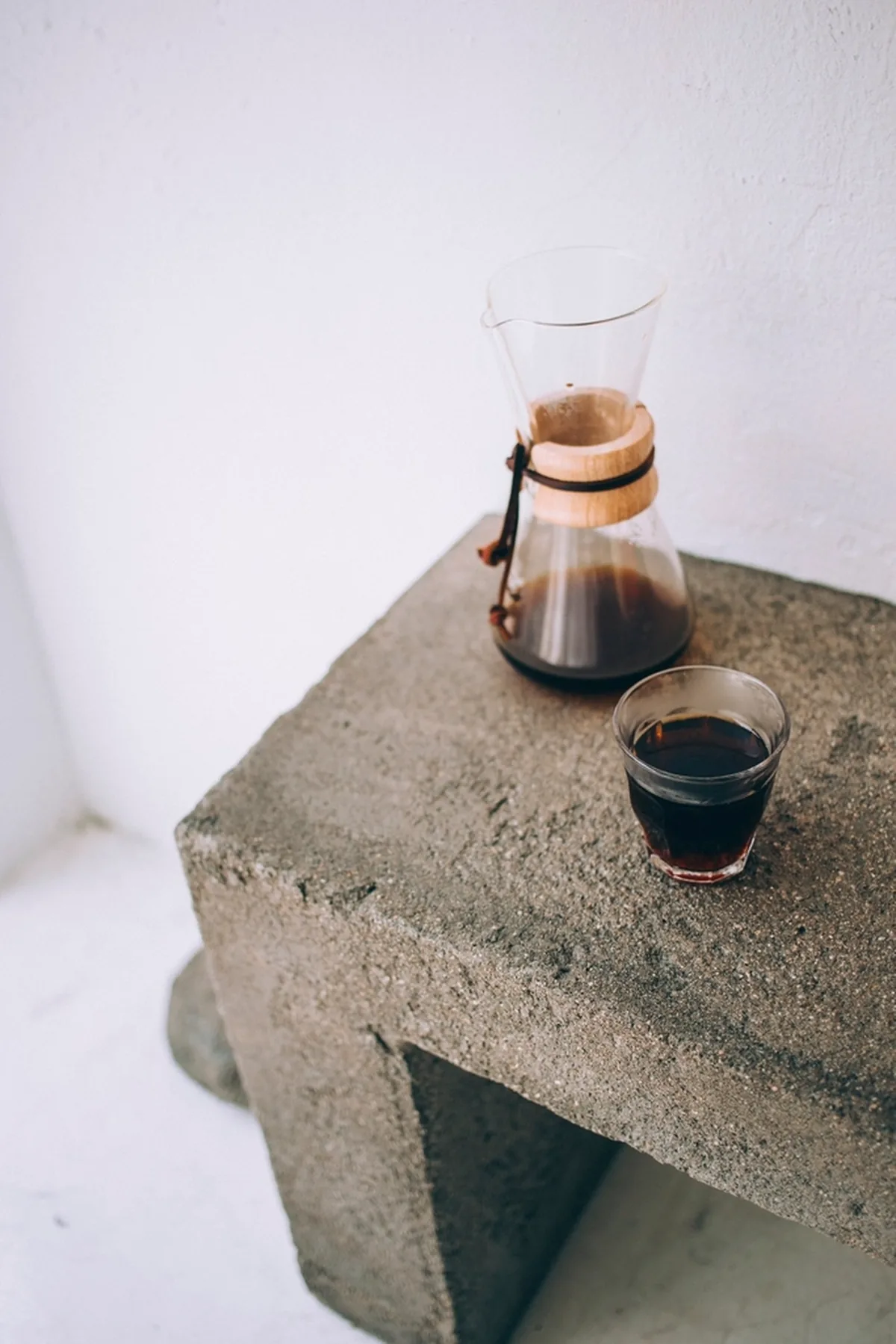
The Chemex is the pour-over brewer that makes the cleanest cup, and the reason is its filter. A Chemex filter is a thick bonded paper, roughly twice as heavy as a V60 filter, and it traps the oils and fine particles that would otherwise end up in your cup. The result is a remarkably clear, sweet coffee with almost no sediment — but only if you brew it the Chemex way, which is slower and coarser than a V60 brew. Treat a Chemex like a V60 and the cup will taste weak and papery; treat it on its own terms and it is one of the best brewers ever made.
The Chemex ratio: 1:16, at a bigger scale
The Chemex ratio is the same 1:16 as any pour-over — one gram of coffee for every 16 grams of water — but the Chemex is built for larger batches. The 6-cup Classic (CM-6A) is the standard size, and its recipe is 30 grams of coffee to 500 grams of water, which makes two full mugs. The 3-cup Chemex suits a single mug at 15 grams to 250 grams, and the 8-cup suits a household at 45 grams to 750 grams.
Do not brew a small dose in a large Chemex. The 6-cup’s wide cone needs a full bed of coffee to extract evenly; 15 grams in a 6-cup leaves the bed too shallow, the water passes through too fast, and the cup tastes thin. Match the brewer to the batch: 3-cup for one mug, 6-cup for two, 8-cup for three or four. If you mostly brew one mug, buy the 3-cup, not the 6-cup — the most common Chemex regret is buying the big one and brewing small in it.
Grind: medium-coarse, one step coarser than a V60
Grind medium-coarse for a Chemex — the grounds should feel like raw sugar, with visible particles and no powder. This is one step coarser than a V60 grind, and the reason is the filter: the thick Chemex paper already slows the flow, so a V60-fine grind would stall the brew completely. If your Chemex brew takes longer than 5 minutes to drain, your grind is too fine. If it finishes in under 3 minutes, your grind is too coarse or your pour was too aggressive.
Fold the filter correctly, because the fold decides whether the brew drains at all. A Chemex filter is a square of paper folded into a cone: unfold it, then fold it so the thick three-layer side sits against the pouring spout. That three-layer side is the vent — it leaves a channel for air to escape from the carafe as the coffee drips in. Put the thick side anywhere else and the filter seals against the glass, the air has nowhere to go, and the brew stalls. This is the single most common Chemex mistake, and it has nothing to do with the coffee.
Water temperature: 94 to 96°C
Use water at 94 to 96°C (201 to 205°F) for a Chemex — slightly hotter than a V60, because the thick filter and the larger dose need more heat to extract fully. Light roasts do best at 96°C; medium roasts at 94 to 95°C; dark roasts at 93 to 94°C, because they extract easily and turn bitter fast. A gooseneck kettle with a temperature display takes the guessing out of this, and the Chemex’s slow brew gives you time to pour carefully.
Rinse the filter with hot water before you add the coffee. This matters more for a Chemex than for any other brewer, because the thick paper carries the strongest papery taste. Pour a full kettle of hot water through the filter, swirl it around the carafe, and discard it. Skip this step and the first sip will taste like wet cardboard, no matter how good the beans are.
The 6-cup recipe, step by step
Weigh 30 grams of coffee and grind it medium-coarse. Fold the filter with the three-layer side against the spout, place it in the Chemex, and rinse it thoroughly with hot water. Discard the rinse water. Add the grounds and shake gently to level the bed.
Bloom with 60 grams of water at 95°C and wait 45 seconds. The bed will rise and bubble as the coffee releases gas. Then pour in slow, concentric circles to 250 grams, wait until the water drains halfway, and pour again to 500 grams. Keep the water level low in the cone — never let the slurry rise above the top of the grounds — and finish pouring by about 2:30. The brew should finish dripping by 4:00 to 4:30. Swirl the carafe gently, pour into two mugs, and taste.
If the cup tastes sour or thin, grind one click finer next time, or raise the temperature by one degree. If it tastes bitter or dry, grind one click coarser, or drop the temperature by one degree. Change one variable at a time, and write it down. The Chemex rewards patience more than any other brewer, and the clean cup it produces is worth the four minutes.
Filters, care, and cost
Chemex filters are the ongoing cost of this brewer, and they are more expensive than V60 filters — budget roughly $10 to $12 for a box of 100, and buy the genuine Chemex-branded bonded filters, not the thin imitations, because the thickness is the whole point of the brewer. The glass carafe cleans with hot water and a bottle brush; the wooden collar comes off for washing. Do not put the Chemex in the dishwasher, and do not pour boiling water into a cold Chemex — the thermal shock can crack the glass. Preheat it with the rinse water and it will last for years.