
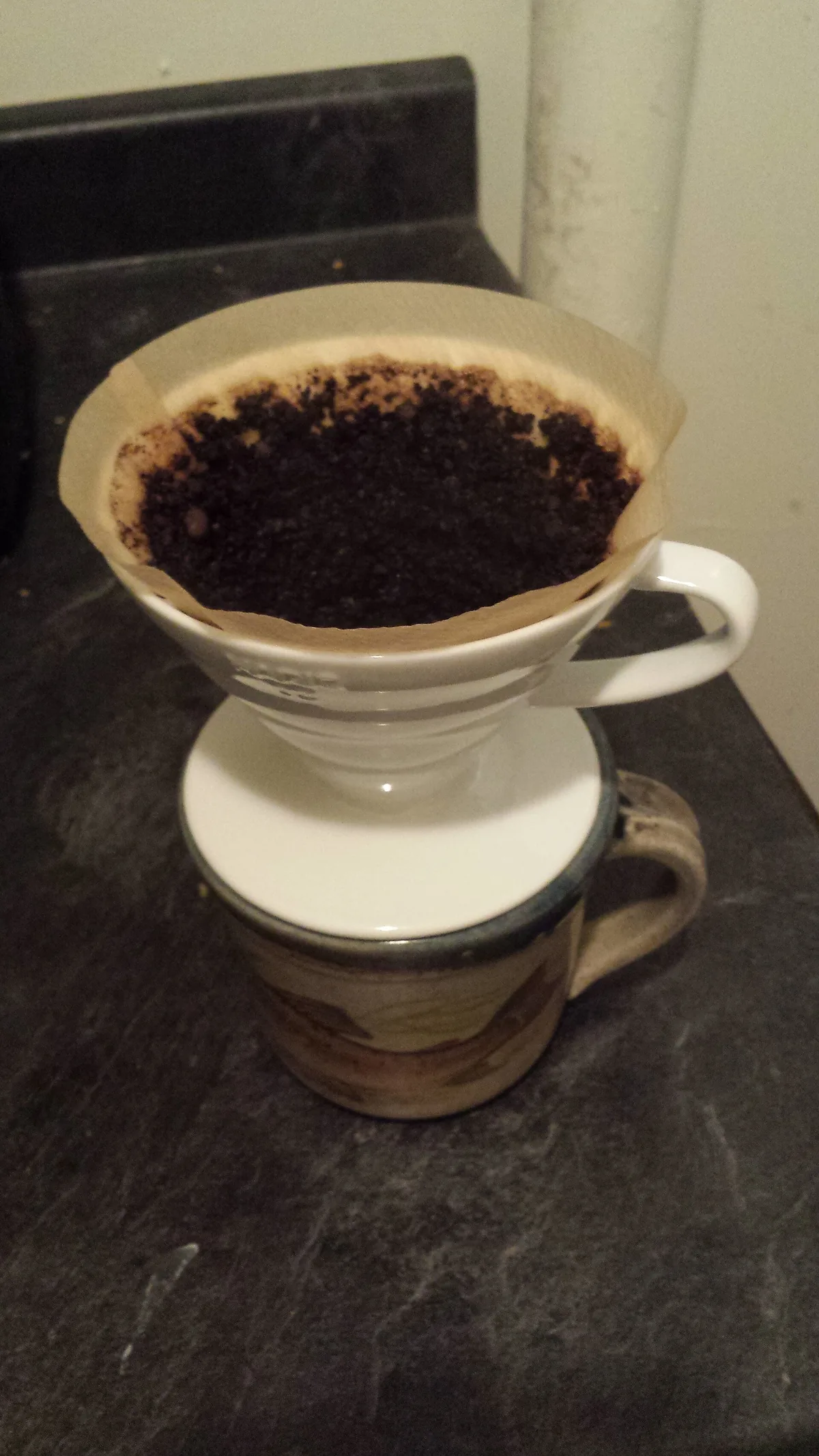
The Hario V60 is the most popular pour-over brewer in the world, and the reason is control. Its cone is a true 60-degree angle with spiral ribs down the inside wall and a single large hole at the bottom, so the water flows fast and the brewer does not set the pace — you do. That control is what makes the V60 capable of the brightest, most detailed cup in pour-over, and it is also what makes it the least forgiving brewer when the technique is off. Learn the method below and the V60 will reward you every morning.
The V60 ratio and grind: 1:16, medium-fine
The V60 ratio is 1:16 — one gram of coffee for every 16 grams of water. For a single mug, that is 15 grams of coffee to 250 grams of water; for two mugs, 30 grams to 500 grams in a size 02 dripper. Use the size 02 for anything from one to four cups; the size 01 is only for a single small cup and is harder to pour evenly because the bed is so shallow.
Grind medium-fine for a V60 — the grounds should feel like coarse sand, with no visible powder and no large chunks. This is the grind that makes the V60 work: fine enough to slow the fast-draining cone, coarse enough to let the water through in about three minutes. Grind too fine and the brew stalls past four minutes and tastes bitter; grind too coarse and the water rushes through in under two minutes and the cup tastes sour and thin. Start at the grinder manufacturer’s pour-over setting — around 18 to 20 on a Baratza Encore — and adjust one click at a time.
Use water at 93 to 96°C (200 to 205°F). Light roasts do best at 95 to 96°C, medium roasts at 94°C, and dark roasts at 93°C. A gooseneck kettle with a temperature display is almost essential for a V60, because the pour is the variable you control most, and you cannot control the pour with a thick-spouted kettle.
The 4-pour method
The most reliable V60 method is the 4-pour method, popularised by the 2016 World Brewers Cup champion Tetsu Kasuya, and it works because it separates the brew into stages you can control. For 15 grams of coffee to 250 grams of water, the pours are: bloom with 30 grams, then pour to 100 grams, then to 150 grams, then to 200 grams, then to 250 grams. Wait for the water to drain halfway between each pour, and finish pouring by about 2:00, with the brew finishing dripping by 3:00 to 3:30.
The bloom is the first pour: 30 grams of water, just enough to wet all the grounds, then wait 45 seconds. Fresh coffee releases carbon dioxide as it wets, and the bed bubbles and rises. If you skip the bloom, the gas pushes the water through unevenly and the extraction is patchy — this is the most common V60 mistake, and the easiest to fix.
After the bloom, pour in slow, concentric circles, starting from the centre and spiralling outward, then back in. Keep the stream thin and the water level low — never pour so hard that the grounds are swimming, and never pour directly onto the paper filter, which sends water straight through without touching the coffee. The spiral matters more than the speed: an even spiral wets the bed uniformly, and a uniform bed extracts evenly.
Reading the drawdown
The total brew time is your diagnostic. If the V60 finishes dripping in under 2:30 for 15 grams, the grind is too coarse or your pours were too aggressive — go one click finer, or pour more gently. If it takes longer than 3:30, the grind is too fine or the filter is clogged with fines — go one click coarser. If the time is right but the cup still tastes off, the problem is the ratio or the beans, not the grind.
Check the coffee bed after the brew. A flat, even bed with no grounds stuck high on the filter paper means the pour was even. A bed that slopes to one side, or grounds plastered up the filter walls, means the pour favoured one side — slow down and keep the spiral centred. This visual check takes five seconds and tells you more about your pour than any timer.
Fixing a bad V60 cup
If the cup tastes sour, sharp, or salty, it is under-extracted. Grind one click finer, or raise the water temperature by one degree, or use a 1:15 ratio instead of 1:16. If the cup tastes bitter, dry, or astringent — the mouth-puckering feeling at the back of the tongue — it is over-extracted. Grind one click coarser, or drop the temperature by one degree, or use a 1:17 ratio. If the cup tastes weak and watery but not sour, the ratio is too weak — move to 1:15. Change one variable at a time, brew again the same way, and write down what you changed.
Rinse the paper filter with hot water before you brew. This removes the papery taste and preheats the dripper, which matters more for ceramic and glass V60s than for plastic — the plastic V60 holds heat well, which is one more reason it is the best first V60 to buy. Pour the rinse water through, discard it, and start brewing. Fifteen seconds, every morning, and the cup is better for it.