
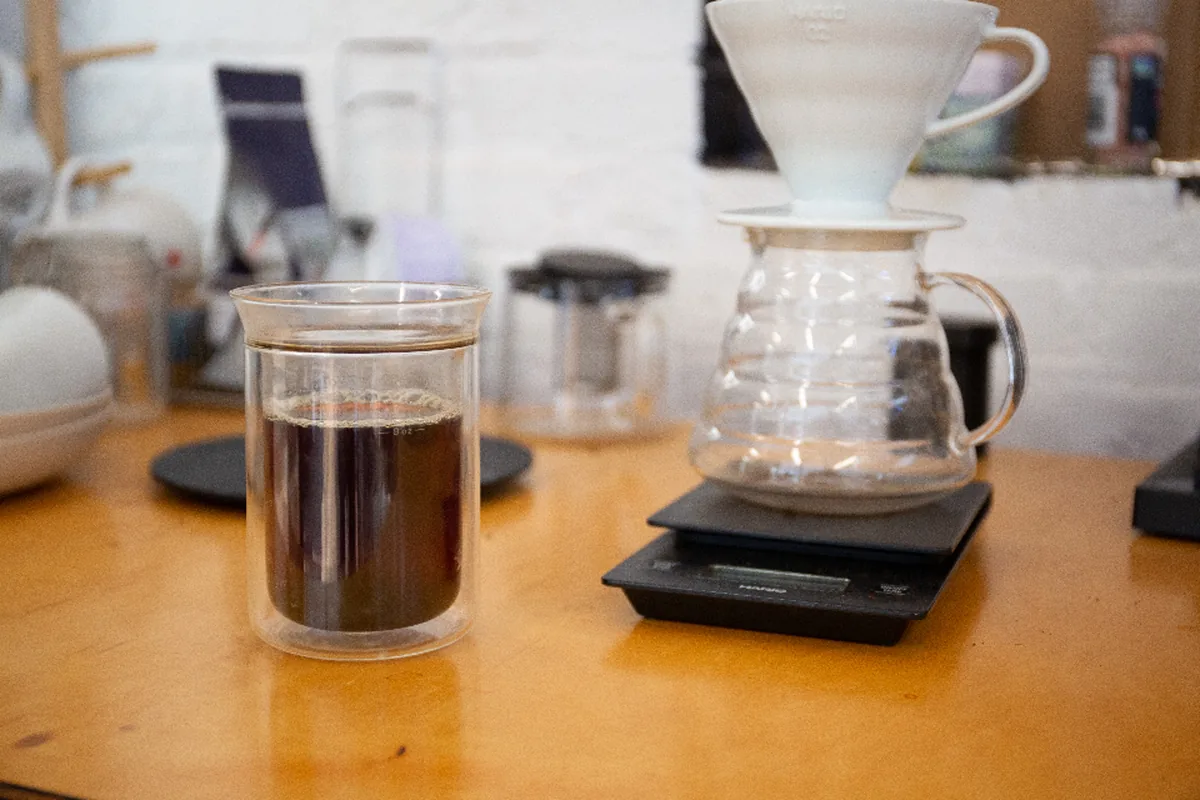
Pour-over coffee for beginners is simpler than the internet makes it look. You need four things: a brewer, a filter, ground coffee, and hot water. Everything else — the gooseneck kettle, the scale, the fancy grinder — makes the coffee better and more repeatable, but none of it is required to make a good cup on your first morning. Start with the minimum, learn the method, and add gear only when you know which variable is holding you back.
The only gear you actually need
A plastic Hario V60-02 dripper costs around $25 and is the best beginner brewer, because it is cheap, unbreakable, and brews as well as the ceramic version. Buy the size 02, which takes 1 to 4 cups, and a pack of 02 paper filters — bleached white filters are the safer choice, because unbleached filters can add a papery taste if you do not rinse them well. You will also need a mug or a small server to brew into, and a kettle — any kettle will do for the first week, though a gooseneck makes the pour much easier once you decide to keep going.
A kitchen scale is the first upgrade to buy, and the only one that matters in the first month. It does not need to be a coffee scale: any kitchen scale that reads to 1 gram will do, and a 0.1-gram scale is better. Without a scale you cannot repeat a good cup, because you are guessing the coffee dose and the water amount every morning. A scale costs less than a bag of good beans and it is the difference between brewing and guessing.
A burr grinder is the second upgrade, and the one that changes the coffee most. The Baratza Encore, at $149.95, is the standard first burr grinder and the one most pour-over brewers use for years. If that is too much to spend on day one, buy whole beans from a local roaster and ask them to grind for pour-over — most will do it for free — and buy the grinder when you are sure pour-over is your method. Do not buy pre-ground supermarket coffee if you can avoid it: it goes stale in days, and stale coffee is the most common reason a beginner’s first cup tastes flat.
The recipe: 15 grams, 250 grams, 3 minutes
Here is the whole method, and it is the same one you will still use a year from now. Weigh 15 grams of coffee and grind it medium-fine, like coarse sand. Rinse the paper filter with hot water and discard the rinse water — this removes the papery taste and preheats the brewer. Add the grounds and shake the brewer gently so the bed is level.
Bloom first: pour 30 grams of water at about 94°C over the grounds and wait 45 seconds. The coffee will bubble and rise as it releases gas; this is normal, and skipping it is the most common beginner mistake. Then pour slowly in circles, starting from the centre and spiralling outward, until the scale reads 150 grams. Wait until the water drains halfway, then pour again in slow circles until the scale reads 250 grams. The whole brew should finish dripping by about 3:00 to 3:30.
Taste the coffee and write down three things: the ratio (1:16), the grind setting, and the total time. Tomorrow, change one thing and write that down too. That notebook is the entire discipline of pour-over, and it is worth more than any piece of gear.
The three mistakes every beginner makes
The first mistake is grinding too fine. Pre-ground coffee sold as “for all methods” is usually ground for a drip machine, which is finer than pour-over needs, and it makes the brew stall and taste bitter. If your brew takes longer than 4 minutes to drain, your grind is too fine — go coarser.
The second mistake is skipping the bloom. Pouring all the water at once floods the bed, the gas escapes unevenly, and the extraction is patchy. Forty-five seconds of patience fixes it.
The third mistake is pouring too hard. A fast, heavy pour agitates the grounds, pushes fine particles to the bottom of the filter, and clogs the flow. Pour slowly, in spirals, with the stream thin enough that you can see the coffee bed through it. A gooseneck kettle makes this easy; a regular kettle makes it hard, which is why the kettle is the upgrade to buy after the scale and the grinder.
Your first week
Day one: brew the recipe above exactly as written, and write down the result. Day two: brew it the same way again, and see if you can repeat it. Day three: change only the ratio — try 1:15 instead of 1:16 — and taste the difference. Day four: change only the grind, one click coarser, and taste the difference. Day five: try a different bean, and notice how the same recipe tastes different. By the end of the week you will know more about your own taste than any guide can teach you, and you will have a recipe that is yours.
Pour-over is a method that rewards a week of attention with years of good mornings. Start with the minimum gear, follow the recipe, change one thing at a time, and write it down. The coffee will take care of the rest.