
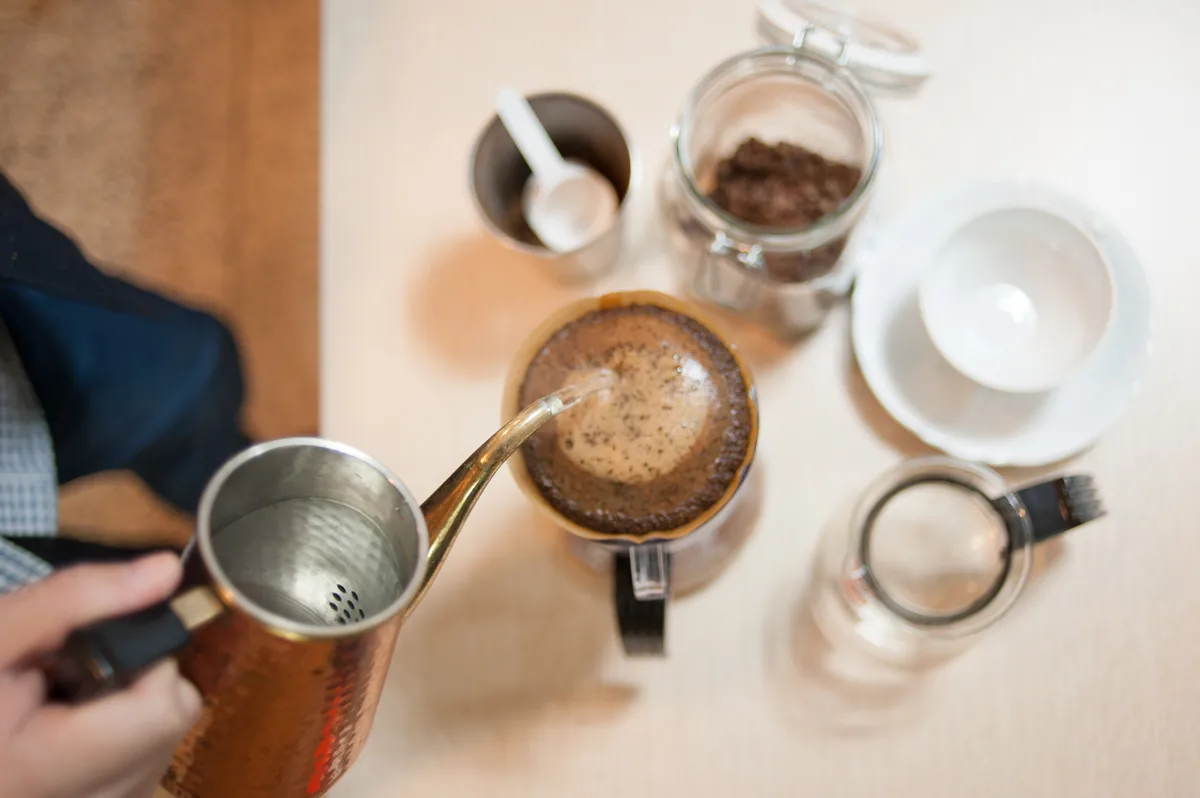
Pour-over coffee is a method, not a mystery. You pour hot water over ground coffee in a filter, the water pulls out flavour as it passes through, and the brewed coffee drips into a cup or carafe. Four variables decide almost everything about the result: the coffee-to-water ratio, the grind size, the water temperature, and how you pour. Get those four right and a $25 plastic dripper makes coffee as good as any café. Get them wrong and no expensive gear will save the cup.
Start with the ratio: 1:16
The ratio is the single most important number in pour-over. Start at 1:16 — one gram of coffee for every 16 grams (millilitres) of water. For a single mug, that is 15 grams of coffee to 250 grams of water; for two mugs, 30 grams to 500 grams. A kitchen scale that reads to 0.1 grams is the one piece of gear that matters more than the brewer itself, because without it you are guessing the ratio every morning and can never repeat a good cup.
Adjust from 1:16 only after you have brewed it the same way three or four times. If the coffee tastes thin, watery, or tea-like, the ratio is too weak — move to 1:15. If it tastes heavy, muddy, or harsh, the ratio is too strong — move to 1:17. Change only the ratio, not the grind or the temperature, so you know what fixed it. Most beginners who think their coffee is “too bitter” are actually brewing too weak and tasting sourness, not bitterness — so try 1:15 before you blame the beans.
Grind: medium-fine, like coarse sand
Grind size controls how fast the water flows through the coffee, and therefore how much flavour it extracts. For a V60, the target is medium-fine — the grounds should feel like coarse sand or raw sugar between your fingers, with no visible powder and no large chunks. For a Chemex, go one step coarser, because its thick filter slows the flow on its own. For a flat-bottom brewer like the Kalita Wave, medium works well.
Grind too fine and the water stalls, the brew drags past four minutes, and the cup turns bitter and astringent. Grind too coarse and the water rushes through in under two minutes, the cup tastes sour and thin, and the grounds look dry and pale when you check the bed. The fix is always one small step on the grinder at a time — a single click coarser or finer — and then brew again the same way. Never change the grind and the ratio on the same morning, or you will not know which one helped.
Buy whole beans and grind them just before you brew. Pre-ground coffee goes stale in days because the surface area is so large; whole beans stay fresh for two to four weeks after the roast date if you keep them sealed and out of sunlight. If your coffee tastes flat and lifeless no matter what you change, old beans are the most likely cause, not your technique.
Water temperature: 93 to 96°C
Water temperature is the second dial, and the range that works is narrower than most people expect. Use water between 93 and 96°C (200 to 205°F). Below 93°C the extraction is weak and the cup tastes sour and underdeveloped; above 96°C you start pulling harsh, bitter compounds out of the grounds. A gooseneck kettle with a temperature display takes the guessing out of this — set it to 94°C and leave it there while you learn.
If you do not have a temperature-controlled kettle, boil the water, then let it sit for 30 to 45 seconds off the boil before you pour. That lands it roughly in the right range. Light roasts benefit from the hotter end of the range (95 to 96°C) because their dense beans are harder to extract; dark roasts do better at the cooler end (93°C) because they give up flavour easily and turn bitter fast. This is the one place where the roast level genuinely changes the recipe, so note it on the bag when you buy.
Use filtered water if your tap water is hard or tastes of chlorine. The Specialty Coffee Association’s water standard calls for a total dissolved solids reading of 75 to 250 parts per million, which is roughly what a basic carbon filter produces. You do not need to buy special brewing water — a jug filter is enough — but brewing with heavily chlorinated tap water will flatten even the best beans.
The pour: bloom, then slow spirals
The pour has two phases, and the first one is the most commonly skipped. The bloom is a 45-second soak: pour just enough water to wet all the grounds — about twice the coffee’s weight, so 30 grams of water for 15 grams of coffee — and then stop and wait. Fresh coffee releases carbon dioxide as it wets, and the bed will bubble and rise. If you skip the bloom and pour all the water at once, that gas pushes the water through unevenly and the extraction is patchy.
After the bloom, pour in slow, concentric circles, starting from the centre and spiralling outward, then back in. Keep the water level low in the brewer — never pour so hard that the grounds are swimming — and pour in two or three pulses rather than one continuous stream. A common pattern for 15 grams of coffee is: bloom with 30 grams, then pour to 150 grams, then pour to 250 grams, finishing around 2:30 to 3:00 total. The exact pulse sizes matter less than keeping the pour slow, even, and controlled, which is why a gooseneck kettle’s thin spout is worth owning.
Watch the clock, not just the water. A V60 brew for 15 grams should finish dripping by about 3:00 to 3:30; a Chemex for 30 grams by about 4:00 to 4:30. If the drawdown is much faster, your grind is too coarse or your pour was too aggressive. If it is much slower, your grind is too fine or the filter is clogged with fines. Total brew time is the diagnostic that tells you which variable to fix next.
Rinse the filter first
Rinse the paper filter with hot water before you add the coffee. This does two things: it washes out the papery taste that unbleached and even some bleached filters carry, and it preheats the brewer and the cup so the coffee does not lose temperature the moment it drips through. Pour the rinse water through, then discard it from the carafe or cup before you start. It takes fifteen seconds and it is the easiest quality improvement in all of pour-over.
A recipe to start with tomorrow
Here is the whole method in one place, for one mug. Weigh 15 grams of coffee and grind it medium-fine. Rinse the filter and discard the rinse water. Add the grounds and level the bed with a gentle shake. Bloom with 30 grams of water at 94°C and wait 45 seconds. Pour in slow spirals to 150 grams, wait until the water drains halfway, then pour to 250 grams. Finish by about 3:00. Taste it, write down what you did, and change one thing tomorrow. That is the entire discipline of pour-over: one recipe, one change at a time, until the cup is the one you want every morning.